Last week Tayahn and I collected as many seeds as possible from capsicums.


Last week Tayahn and I collected as many seeds as possible from capsicums.
Last week our class made preservatives that included peaches, blackberries, corn and Kombucha.
Tayahn and I were peeling and cutting peaches that were going to be turned into a jam.
Tohe made blackberry jam, Bella and her group transferred the kombucha to another jar and Zacchaeus and his group cut the corn.
All of that was added to a separate pot and cooked till it was a jam consistency.
That was last weeks experience.


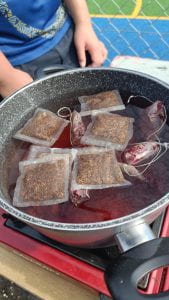
Last week Tayahn, Khadyn, Maia and myself made kombucha. We added 10 red tea bags and 10 regular tea bags to a pot of water. Then we boiled the tea bags and Tayahn added 1 cup of sugar. We then waited for the sugar to dissolve and scooped the teabags out leaving the remaining liquid. That is it.
Today we are learning how to use language features to create an image in our readers mind.
Here are a few things that describe me:
I am as short as a dwarf.
My eyes are hazel like a freshly fallen leaf.
I stand tall like a barely grown tree.
I swim like a jelly fish that’s being pulled by the currents.
I fear things in the dark like the light of the sun.
I value my family and friends.
When I’m nervous I suddenly feel butterflies in my stomach and my face turns red .
My favourite sport is Volleyball.
My favourite snack is chocolate
My favourite movie is Fast n Furious 1,2,3,4,5,6,7,8,9.
Like a pig, my favourite time of the day is eating.
My favourite memory of childhood is not having to care about looks or having the freedom to be immature.
These past weeks Calla, Tayahn and I have been analysing parts of Philippine culture and we chose to do mythology and a weapon. Here is our work:
Bolo Kampilan

Kampilan is a traditional, long bladed sword from the Southern Philippines.
It weighs around 1.3 kgs and the length is at least 90-100 cm long.
The term “Kampilan” isn’t just a type of weapon but also a word that actually means sword. g
It has a single-edged blade that flares near the tip and different types of hilts
based on animals such as: Hornbill bird, Crocodile, Naga (type of snake), Cockatoo, Dragons and Lizards. (A hilt being the handle of the sword.)
The reason for the hilt being shaped like that, is just to symbolise an open mouth of a mythical creature. There is a rounded part on the hilt which is an eye of the animal that is created.
The hilt is sometimes wrapped with rattan to improve the grip. Rattan being joined stems from a palm tree.
There is also a guard just before the hilt to protect your hand from sliding upwards and getting cut.
The traditional materials to create this sword are a high quality steel used for the blade and then the hilt that is made from hardwood, bone or ivory which is then carved into the mouth of an animal.
It’s also a sign of heroism and resistance. It originated as an agricultural tool for tasks like clearing vegetation, over time; it evolved into a weapon used for closed quarter combat. It existed long before Spanish colonization During the revolution against Spanish colonial rule, the bolo became a symbol of freedom. Filipino revolutionaries, organized in the secret society known as the Katipunan, were known to carry bolos on their belts. The bolo remains in use today in Filipino martial arts, such as Arnis, and is still made as both a tool and a commemorative item.
This weapon is primarily used by the Moro people who are native muslim inhabitants.
They are the descendants of Malay, Indian and Arab.
Mythical Creature Tikbalang
A bony humanoid (half human from neck down and half horse on the head and feet/hooves with exaggeratedly long limbs and hands in twisted claws) shape-shifting, disappearing creature living in dense forests and remote areas if you are alone near or in a forest it will shape shift try take you in deeper and deeper then eventually leave you there very sick or likes making travelers go off course making them lost in the forest , playing tricks and pranks on people this legend is also a warning to never follow people into the woods and never trust strangers.
Tikbalang Song- Tikbalang
This past week we have watched and identified many different dialogue, camera angles and techniques in this film, called Mr Frosty and the BMX kid. This short film consists of a small Maori boy (The BMX kid) and a grumpy old man (Mr Frosty) who claims to be god and the boy does not believe him until they do some manus and he pulls a fattie manu impressing him instantly. Soon after the hunger for ice cream kicks in and they become best mates and then get ice cream with loads of sprinkles for both of them to enjoy. By Riah and Calla.
| Line of Dialogue | Who Said It? | Tone (e.g. sarcastic, hopeful, sad) | Why is this Important? (What does it tell us about the character, mood, or story?) |
| “It’s good to come home now and then eh bro? Eat some ice creams, do some bombs.” | BMX Boy. | Glad and grateful. | The Character is a boy that does not believe you can’t do anything by age and is a very mindful kid. |
| “We call it Aotearoa around here bro.” | BMX boy | Tellingly and respectfully | Informing him the correct name this shoes he is tangata whenua |
| “That’s what my mum always says.” | BMX boy | Nostalgic | That he takes his mothers words to heart. |
| “Well, you can be whoever you want to be, I guess.” | BMX boy | Not convinced | He said that he thinks and believes you can be whoever you want to be. |
| “I just felt I had to come back here, back to my eden” | Mr Frosty | Mysterious, eerie,longingly | Longs to come back to his place of nostalgia and perfection and because it is beautiful. |
| “You want a bomb, i’ll show you a bomb” | Mr frosty | Angry | Short tempered easily teased |
– What have you been learning about? Film techniques and dialogue
show the trailer:
At the moment my class and I have been reading and studying a book called Wild Pork and Watercress.
The aim of the novel study is to build our understanding of literary aspects.
We have finished reading 5 chapters so far and learnt a lot about different sorts of relationships that happen in one relationship.

Here is a quick informative slide about chapter 1:

In this slide are some questions we answered from chapter 2:

This is my reflection on the first 2 chapters of the novel.
Welcome to your brand new blog – a space to share your learning journey.
To get started, simply visit your blog’s dashboard, edit or delete this post and check out all the other options available to you.
We can walk you through step-by-step in our guide to getting started with your blog.
You can see what other learners are sharing on their blogs here.
Happy blogging!